

If you’re considering braces or clear aligners, your orthodontist may recommend a procedure called IPR, short for Interproximal Reduction.
For many patients, hearing that a small amount of enamel may be removed from between their teeth can sound intimidating. Fortunately, IPR is a common, conservative orthodontic technique that has been safely used for decades to create space and improve treatment outcomes.
Let’s take a closer look at what IPR is, why it’s used, and whether it’s something you should be concerned about.
What Does IPR Mean?
IPR stands for Interproximal Reduction, sometimes referred to as:
- Tooth slenderizing
- Interproximal enamel reduction
- Tooth reshaping
- Orthodontic stripping
The procedure involves removing a very small amount of enamel from the sides of selected teeth to create additional space for tooth movement during orthodontic treatment.
In most cases, the amount removed is extremely small and often not visible to patients.
Why Is IPR Used?
One of the biggest challenges in orthodontics is creating enough space for teeth to move into proper alignment.
IPR may be recommended when patients have:
- Mild to moderate crowding
- Teeth that are slightly too wide
- Small spacing discrepancies
- Black triangles between teeth
- Minor bite alignment issues
Instead of removing a tooth, orthodontists can sometimes create the necessary space through carefully planned enamel reduction.
How Much Enamel Is Removed?
Much less than most patients imagine.
Typically, only fractions of a millimeter are removed from selected tooth surfaces. The goal is to create just enough space to improve alignment while maintaining the health and strength of the teeth.
Because enamel has no nerve endings, most patients experience little to no discomfort during the procedure.
Does IPR Hurt?
For most patients, no.
During the procedure, you may feel:
- Mild pressure
- Gentle vibration
- Slight sensitivity
However, IPR is generally considered painless and usually does not require anesthesia. Any minor sensitivity that occurs afterward is typically temporary.
Is IPR Safe?
Yes.
When performed by an experienced orthodontist, IPR is considered a safe and predictable procedure. Research has shown that carefully planned enamel reduction can be performed without negatively affecting long-term tooth health.
Orthodontists carefully evaluate:
- Tooth size
- Enamel thickness
- Bite relationships
- Treatment goals
before recommending IPR.
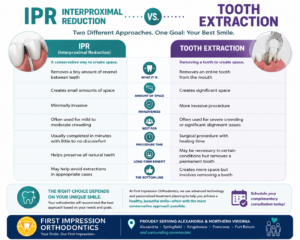
For appropriate candidates, IPR can provide enough room for successful orthodontic treatment without removing permanent teeth.
Is IPR Used with Clear Aligners?
Absolutely.
IPR is frequently incorporated into clear aligner treatment plans because aligners often require small amounts of additional space to achieve ideal tooth positioning. Studies show a large percentage of aligner patients receive some form of interproximal reduction during treatment.
IPR may also be used with:
- Traditional braces
- Ceramic braces
- Adult orthodontics
- Retreatment cases
Can IPR Help Fix Black Triangles?
Yes.
Black triangles are small dark spaces that sometimes appear near the gumline between teeth.
In some cases, IPR can reshape tooth contact points and help reduce the appearance of these spaces by allowing teeth to fit together more naturally.
Orthodontic Treatment in Alexandria, VA
At First Impression Orthodontics, we use advanced orthodontic treatment planning to help patients achieve healthy, beautiful smiles while minimizing unnecessary procedures.
Patients throughout:
- Alexandria
- Springfield
- Kingstowne
- Franconia
- Fort Belvoir
- Northern Virginia
trust our team for customized orthodontic care designed around their unique needs and goals.
Whether you’re considering braces or clear aligners, we can help determine whether IPR may be part of your treatment plan.
Meet the Orthodontists at First Impression Orthodontics
Successful orthodontic treatment depends on precise planning and attention to detail.
Dr. Lu and Dr. Schneider carefully evaluate tooth size, spacing, bite relationships, and facial aesthetics before recommending any treatment approach. Learn more about our team’s experience and patient-centered philosophy.
Visit Our Alexandria Office
If you’re curious about clear aligners, braces, or IPR, schedule a consultation at our Alexandria orthodontic office. Our team is happy to answer your questions and explain every step of your treatment plan with a complimentary consultation.
Frequently Asked Questions
What does IPR stand for in orthodontics?
IPR stands for Interproximal Reduction, a procedure that removes a very small amount of enamel between teeth to create space for orthodontic treatment.
Why do orthodontists perform IPR?
Orthodontists use IPR to create space, improve tooth alignment, reduce crowding, and sometimes help avoid tooth extractions.
Does IPR hurt?
Most patients experience little to no discomfort. Because enamel contains no nerves, IPR is generally considered painless.
Is IPR safe?
Yes. When performed by a trained orthodontist, IPR is considered a safe and effective orthodontic procedure.
How much enamel is removed during IPR?
Only a very small amount of enamel is removed, typically fractions of a millimeter from selected tooth surfaces.
Is IPR necessary for clear aligners?
Not always. However, many clear aligner treatment plans use IPR to create space and improve tooth movement.
Can IPR help avoid tooth extractions?
In some cases, yes. IPR may create enough space to align teeth without removing permanent teeth.
Can IPR fix black triangles between teeth?
Yes. In some patients, IPR can reshape tooth contact areas and help reduce the appearance of black triangles.